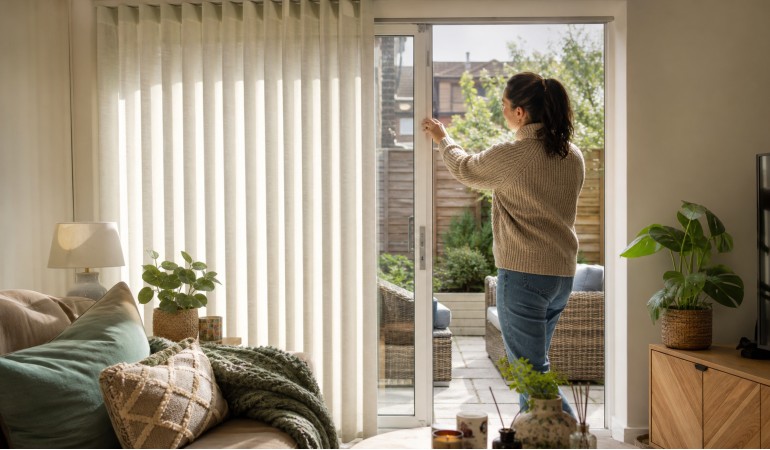
Picking the right blinds for patio doors sounds simple until you’re standing in front of a six-foot wide opening, wondering how on earth you’re going to cover it without making the room look worse than before.
Patio doors are one of those things that look brilliant in a house but become a real headache the moment you try to dress them. They’re tall, they’re wide, they get used constantly, and they face the outside world. Privacy, light control, and temperature all come into play at once.
Figuring out what blinds are best for patio doors isn’t just about picking something that looks nice. It’s about finding something that actually works for how you live.
Table of Contents
What Makes Patio Doors So Difficult to Dress?
Patio doors are tricky to cover because they combine a large surface area with high daily use. The blinds need to stay out of the way when the door opens, provide genuine privacy and light control when closed, and hold up to constant movement without looking tired after six months.
Think about it. A standard window sits there all day doing nothing. Your patio door gets opened and closed dozens of times, especially in summer. Whatever you hang on it needs to cope with that movement without tangling, drooping, or getting caught every time someone wants to step outside. Because patio doors are often floor-to-ceiling, there’s a lot more fabric or material involved. Weight, hang, and fitting precision matter far more than they would on a small bedroom window.
Light control is a bigger issue here than most people expect. A south-facing patio door can turn your living room into a greenhouse by mid-morning in July. At night, without the right blind, you’re essentially performing your evening routine for the entire street. These aren’t small irritations. They’re the things that make or break how comfortable your home actually feels.
Check also:
Blinds vs Curtains: Which is Best for Your Home?
Which Types of Blinds Work Best for Patio Doors?
The three types that consistently perform best are vertical blinds, roller blinds, and perfect fit blinds. Which one suits you depends on your door type, how often you use it, and how much light and privacy control you need. Each has a clear strength.
Vertical Blinds
Vertical blinds are probably the most common answer to what blinds are best for patio doors, and they’ve earned that reputation honestly. The slats hang down vertically and rotate to let light in at different angles, or draw to one side to leave the doorway completely clear. That last part is the key feature. You can open them without pulling the whole blind away from the door.
They work particularly well on sliding patio doors because they move in the same direction as the door itself. No bunching, no awkward tucking, just a smooth sweep to the side. They come in a wide range of fabrics, from sheer voiles that soften the light to room-darkening materials that block it out properly. If your patio door faces a busy garden or street, vertical blinds give you real control without having to choose between light and privacy.
Roller Blinds
Roller blinds are the sleek option. If you want something that virtually disappears when you don’t need it, a roller blind is hard to beat. It rolls up into a compact tube at the top, leaving your door almost entirely unobstructed when raised. That minimal look suits modern interiors well, especially in kitchens and open-plan spaces where you don’t want a lot of visual noise.
Blackout materials work well for rooms that get a serious amount of morning sun. Light-filtering and sheer fabrics take the edge off the glare without blocking the view entirely. The main thing to watch with roller blinds on patio doors is size. Wider doors may need a specially sized or made-to-measure blind, and a large roller blind made from cheaper materials can sag in the middle over time. Spending a bit more up front on a quality blind will save you from replacing it every couple of years.
Perfect Fit Blinds
Perfect fit blinds are designed to sit within the frame of the door, making them a brilliant solution for French doors and bi-fold doors. They clip into the frame without drilling, screws, or brackets. That means they move with the door itself rather than staying fixed to the wall or ceiling, which solves the problem entirely when you’ve got doors that fold back on themselves or swing open.
They also add a layer of insulation that other blinds struggle to match, because they sit flush against the glass with very little air gap. In winter, that makes a noticeable difference to how warm the room feels near the door. They look incredibly neat, and because they’re fixed to the frame, there’s no flapping about when you open the door. For bi-fold doors especially, perfect fit blinds are genuinely one of the best options available.
What Should You Actually Look for When Choosing?
The right blind for your patio door depends on more than just the style. Getting this wrong is easy, and it’s usually down to overlooking a few practical details before buying.
- Material is the first thing to think about. Fabric blinds look great but need regular cleaning and can fade in direct sunlight over time. PVC and wipe-clean materials are far more practical if your patio door opens onto a muddy garden, which in the UK is a realistic possibility for about ten months of the year. Faux wood and aluminium slats sit somewhere in the middle: a more structured look with decent durability.
- Colour matters more than people expect. A blind that clashes with your interior or cuts the room in half visually makes the space feel smaller and more cluttered. Neutral tones tend to work well because they don’t compete with the view outside. That said, there’s no rule against going bold if the rest of the room can carry it.
- Safety is non-negotiable in family homes. Corded blinds are a serious hazard for young children, and the UK guidance is clear: corded window coverings should not be used in rooms where children sleep or play unsupervised. Cordless designs and those with built-in tension systems are the safer choice. They’re also easier to use day-to-day, which is a welcome bonus.
- Durability comes down to how often the door gets used. A patio door in a busy household needs blinds built to handle constant movement. Cheaper options often don’t hold up. A slightly higher upfront cost tends to save money over time.
Check also:
5 Essential Steps for Perfectly Fitting Your Roman Blinds
Are Smart Blinds Worth It for Patio Doors?
Motorised and smart blinds have moved from luxury add-on to genuinely practical home feature over the last few years. If you use your patio door regularly, the convenience alone makes them worth considering.
You can now get blinds that connect to your home’s Wi-Fi and are controlled via a smartphone app or paired with voice assistants. That means closing your patio door blinds from the sofa, from upstairs, or from the office if you’ve left the house and realised the afternoon sun is about to bake the room. It’s a small thing, but it’s the kind of small thing that quickly becomes hard to live without.
From a security angle, it’s worth thinking about too. Blinds that open and close on a schedule can make the house look occupied when you’re away, which is a low-effort deterrent. Some systems set timers based on sunrise and sunset, so the blinds adjust automatically throughout the day without any input from you.
Energy management is another genuine benefit. Smart blinds can help regulate room temperature by closing automatically when the sun hits the glass. That reduces heat gain in summer and cuts heat loss in winter. Over time, that contributes to lower heating bills. For patio doors, which are often the largest and most thermally vulnerable part of a room, that’s a fairly compelling argument for upgrading.
Check also:
Fitting Your Venetian Blinds Correctly
How Do You Measure and Fit Patio Door Blinds Correctly?
Accurate measuring is the most important step, and it’s where most people go wrong. Get this right, and everything else is straightforward. Get it wrong, and you’re either sending the blind back or living with gaps.
For blinds that sit inside the frame, measure the width at three points: top, middle, and bottom. Use the narrowest measurement. For blinds that sit outside the frame, add at least 5cm to each side. That ensures proper coverage and stops light creeping around the edges.
Factor in how the door opens before you commit to anything. A blind positioned too close to the door’s swing path will get caught and damaged quickly. If you’re fitting blinds to a sliding door, check that the track or fitting won’t obstruct the sliding mechanism.
If measuring and fitting feels like too much, it genuinely pays to bring in a professional. A blinds fitting service takes the guesswork out entirely and ensures everything hangs straight, operates smoothly, and won’t need to be redone a few months down the line.
Check also:
How to Put Up a Curtain Pole Successfully
Quick Maintenance Tips
For maintenance, keep it simple. Fabric blinds respond well to light vacuuming with a brush attachment every few weeks, which stops dust from building up in the folds. Wipe-clean and PVC options just need a damp cloth. Check the mechanisms periodically, especially on frequently used doors. A quick inspection of cords, motorised parts, or chain mechanisms every few months catches small problems before they become expensive ones. On vertical blinds, clean the tracks regularly so the slats glide smoothly and don’t start catching mid-pull.
Need help with blind fitting? Book with Fantastic Handyman today!
Enter your postcode to view our rates and availability in your area.
For questions about the services we offer visit our main site
Takeaways
- Vertical blinds are the go-to choice for patio doors because they slide open easily and handle large surface areas well.
- Roller blinds offer a clean, minimal look and come in blackout or sheer options to suit different light needs.
- Perfect fit blinds are ideal for bi-fold and French doors, offering energy efficiency without requiring any drilling.
- Cordless and child-safe designs are essential if you have young children or pets at home.
- Motorised blinds can be controlled via smartphone or voice assistant, adding both convenience and a basic security benefit.
- Always measure your door accurately before buying, and factor in door swing or slide direction.


Leave a Reply