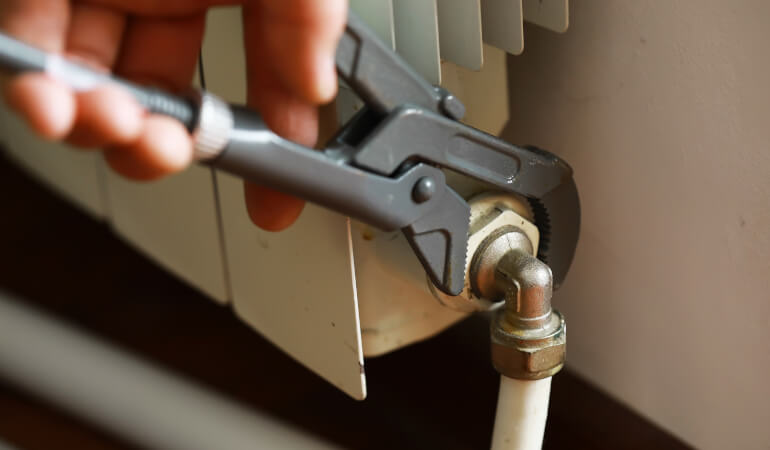
Radiator knobs break or go missing. That’s life, what can you do? Sadly, this always happens either in the middle of winter or just before summer. You’d think a broken radiator knob is a common problem in older homes, but more often than not, it occurs after DIY work or a bad repair.
Fortunately, now you will learn how to turn the radiator off with no knob, so don’t worry.
But first, let’s explore…
Table of Contents
The role of a knob in a radiator system
A radiator knob may look like a simple handle, but it does an extremely important job: it controls how much heat enters the radiator. You turn it up for more heat and down for less. Amazing how one small thing can have so much power, isn’t it?
Before you do anything about a broken or missing knob, however, it helps to know what type of system you have.
- Hot water systems (found in most UK homes) use water heated by a boiler and pumped through radiators. The knob controls a valve that limits or stops water flow. When you turn the right valve fully off, you can shut the radiator down.
- Steam systems (found in historic houses, listed buildings and public buildings) rely on steam rising through pipes. Valves usually need to be either fully open or fully closed. If you only partially close them, it can cause noise, leaks, or damage.
When dealing with a broken radiator knob, you are really dealing with the valve underneath. Let’s look at the anatomy of the system as a whole and how each part relates to the knob.
- Thermostatic Radiator Valve (TRV) – The most common modern type. The knob senses room temperature and adjusts flow on its own. If the head breaks or comes off, the pin beneath may stick open.
- Manual radiator valve – A simple on/off or flow control valve. When you turn the knob, it directly opens or closes the valve.
- Lockshield valve – Found on the opposite side of the radiator. It balances the system, not for daily control. It usually sits under a plastic cap and has no normal knob.
- Valve spindle or pin – The small metal pin inside the valve. If this sticks, the radiator may stay hot even with no knob fitted.
- Pipes – These carry hot water or steam in and out. Valves sit between the pipe and the radiator, which is why shutting the right valve stops the heat.
Do all radiators have shut-off valves? In most cases, yes. Even old radiators usually have at least one valve. It may hide under a plastic cap, so it is easy to miss. You may also wonder, do both valves on a radiator need to be turned off? Often times yes. When you turn off only one valve, it may slow the heat, but it does not stop it fully. When both valves are closed, it gives a clean shut-off.
Check also:
Is Your Towel Rail Too Hot or Cold? Here’s How to Adjust It Just Right!
Now let’s look at some of the reasons why you may have a broken radiator knob...
- Some radiators were installed with only a lockshield valve. The latter was never meant for daily use.
- The plastic head can crack or fall off. When it does, it leaves just the metal valve body behind.
- A past owner or tenant may remove the knob for different reasons.
Mind you, even if the knob was removed, a stuck pin can hold the valve open. Also, many people mistake the capped lockshield for a missing knob. It is hidden on purpose because it’s not designed for frequent turning.
Now let’s get to the reason why you are here. What are the…
What’s wrong with your heating?
Choose the symptom that matches your radiator or boiler. We’ll tell you if it’s a safe DIY fix — or a job that legally must go to a Gas Safe registered engineer.
Gas Safe law – read this first
- Any work on a boiler or gas appliance must be carried out by a Gas Safe registered engineer — it’s illegal and dangerous otherwise.
- If you smell gas, feel unwell, or suspect a leak: stop, ventilate, and call the National Gas Emergency line on 0800 111 999.
Pick your symptom
Select the closest match — the result updates instantly.
—
Heating problem you can’t fix?
Book a plumber or a Gas Safe registered engineer with Fantastic Handyman — fast, vetted and fully covered.
Book an engineer →Guide only. If in doubt, isolate the water/electric and call a professional. Prices at fantastichandyman.co.uk/prices.
Steps to turn your radiator off when the knob is broken or missing
It feels tricky to turn a radiator off with no knob, but it doesn’t have to be.
Step 1: Safety tips before you start
Radiators can get hot, and so do pipes. Water systems can also leak if something goes wrong. Bad work can lead to leaks, water damage, or full system failure. For those reasons, you should be very confident in your capabilities. And if not, just call a Gas Safe registered engineer.
Now, on to how to turn the radiator off with no knob. Make sure no one else touches the heating controls while you work. One change from another room can ruin the whole job.
- Switch the boiler off. You can also set the central heating to off at the controls. This stops hot water from moving through the system.
- Wait for the radiator and pipes to cool.
- Put towels down around the radiator. Floors stain fast, especially wood or carpet. A small container also helps if water drips out.
After that, grab these tools:
- Adjustable wrench
- Pliers
- Flathead screwdriver
- Towel
- Small container
- Protective gloves
Check also:
5 Things You Need To Know About Gas Safety
Step 2: Inspect the side with the missing knob
Check which side of the radiator is missing the knob. You need to know if it’s the TRV side or the lockshield side as each one controls the radiator in a different way.
TRV valve
A TRV controls how much hot water flows into the radiator. It reacts to room temperature and opens or closes on its own to keep the space comfortable. When this valve is shut off, hot water can no longer enter the radiator, so it cools down completely.
If the knob or head is missing, the valve itself may still work. Under the missing knob, there is usually a small metal pin. If that pin is pressed fully down, the valve closes and stops the flow of hot water. In some cases, the pin sticks in the open position, which is why the radiator stays hot even without a knob. Gently pressing the pin can sometimes shut the valve, but it must move freely for this to work.
Lockshield valve
A lockshield valve controls how quickly water leaves the radiator. Its main job is to balance the heating system so all radiators warm up evenly. When this valve is shut off, water can no longer flow out of the radiator, which effectively stops circulation through it.
You already know that, unlike a TRV, the lockshield is not meant for daily use and usually sits under a plain plastic cap. If this is the side with the missing knob or cap, shutting the valve will isolate the radiator.
Step 3: Remove the plastic cap to access the spindle
If the valve has a plain plastic cap, gently remove it to expose the valve spindle underneath. In most cases, you can remove the cap with your hands, or a pair of pliers. Apply only light pressure.
Once the cap is off, you should see the valve spindle. This is a small metal stem, usually square or slotted at the top, designed to be turned with a spanner or grips rather than a normal knob. On older systems, the spindle may look worn, stiff, or slightly corroded.
Older spindles can be fragile, and forcing them can snap the stem or damage the valve body. If it does not move easily, stop and apply steady, gentle pressure rather than sudden force.
Step 4: Turn the spindle clockwise to close the valve
Once the spindle is exposed, you can close the valve by turning it clockwise. Use a pair of pliers or an adjustable spanner for better grip. Always turn slowly and carefully. The goal is to push the valve pin down to stop the flow of water.
Typically, a radiator valve takes around half to one full turn from the fully open position to fully closed. Everyone’s system is slightly different, so the exact number of turns may vary. Count the turns as you go. This is important because you may need to return the valve to its original position later.
Be mindful of any warning signs that you are turning too hard. If you hear creaking, feel unusual resistance, or see the spindle bending, stop immediately. If you force the spindle, it can break. You can also damage the valve, which may lead to leaks or require a full replacement.
Step 5: Double-check if the radiator cools down
After 10 to 15 minutes have passed, touch and feel the inlet pipe near the valve. It should start to feel cooler. The radiator should cool down slowly from top to bottom. That tells you the valve is shut and hot water no longer flows in. If it stays warm after this time, the valve may not be fully closed.
Important: Do not force the valve if it feels fully stuck. Extra pressure can snap the spindle or crack the valve body. That leads to leaks fast. Also, do not try to remove the full valve from the radiator. This can cause major water leaks and flood the room. Finally, do not use WD-40 or other lubricants on heating valves. These products can damage seals and cause drips later on.
Radiator still won’t turn off? It may be time to contact a specialist
Sometimes a radiator just refuses to switch off. You follow every step, yet the room still feels warm. When this happens, it is often a sign that the problem sits deeper in the system.
One common issue is a valve spindle that spins but does nothing. It turns, but it no longer engages with the valve inside. Another problem links to TRVs. The internal pin can stick in the open position. Even when the spindle sits fully closed, hot water still enters the radiator. This makes it feel like the valve has no effect at all.
Leaks also matter. Water around the valve body, even a slow drip, points to failure. If you leave this unchecked, it can damage floors or drop system pressure. Heating issues elsewhere in the house can play a part too. If the boiler still calls for heat in other rooms, warm water may pass through this radiator anyway. Poor system balancing can let heat sneak through when it should not.
Keep an eye on the boiler pressure. If the central heating pressure drops, a valve fault or hidden leak may be the cause. If the radiator stays hot with the spindle fully closed, stop. Do not force it. This is the right moment to call a heating engineer or plumber.
Don’t risk further damage! Schedule your boiler & heating service today!
Enter your postcode to view our rates and availability in your area.
For questions about the services we offer visit our main site
Simple radiator maintenance tips to save you from future troubles
A little care now can prevent big headaches later.
Start with an annual boiler and heating checkup. This keeps the system safe and helps spot valve issues early, before they become costly problems. While you’re at it, replace old valves before winter. Cold weather puts extra strain on tired parts, and new valves give better control with fewer surprises.
TRV heads also need attention. Keep them clean and dust-free, because dust can stop the internal pin from moving as it should. A quick wipe now and then goes a long way.
Finally, check for stiffness at the start of each heating season. Turn each valve gently and feel for resistance.
Check also:
Your Domestic Water Pressure is Too High? Find Out What To Do!
Takeaways
- Most UK homes use hot water systems, whereas most historic or large buildings have steam. Know what you are dealing with.
- Radiator knobs control heat flow, but the real control is the valve underneath. Even without a knob, the valve can often still be adjusted directly.
- Always be very careful when you handle the valve spindle.
- After you close the valve, the radiator and inlet pipe should cool slowly over 10 to 15 minutes. If it stays hot, the valve may not be fully closed.



Leave a Reply